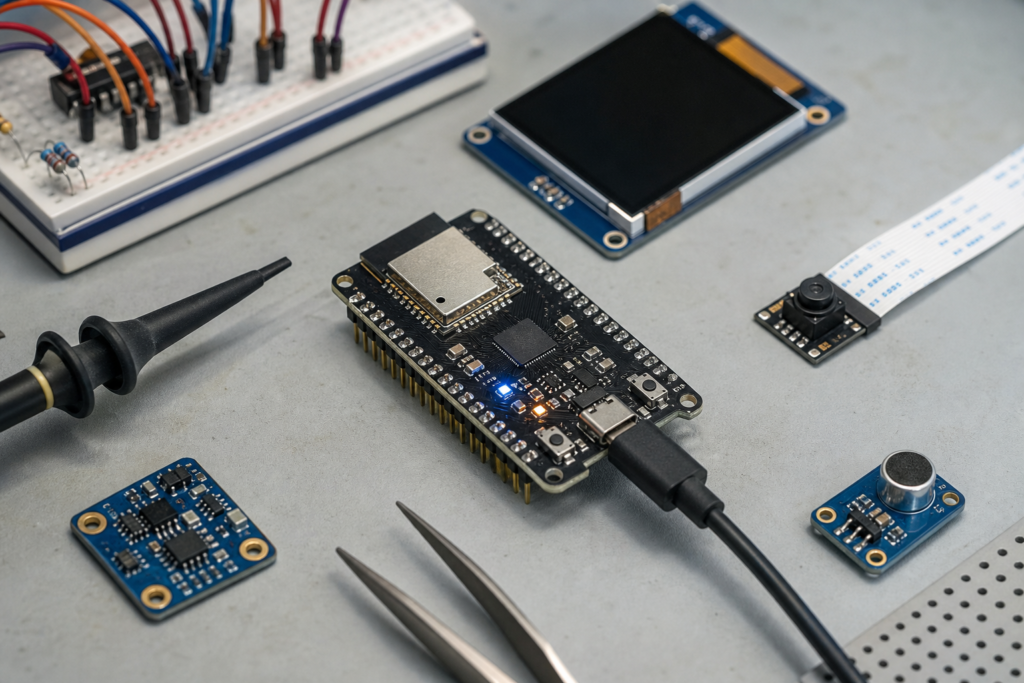
ESP32-S3 in 2026: Why Voice and Display Boards Keep Selling
ESP32-S3 keeps turning up in current board demand for one simple reason: it sits right in the middle of several product trends that are still moving fast. Teams want low-cost connected hardware, but they also want small displays, local voice input, camera options, and enough application headroom to make the product feel modern instead of bare-minimum.
That is why ESP32-S3 boards keep staying visible in current module traffic, display kits, voice boards, and AI hobby-to-commercial crossover projects. It is not the highest-end compute platform in the room. It is the part that often gets chosen when the project has to be practical, quick to build, and still flexible enough for the next revision.
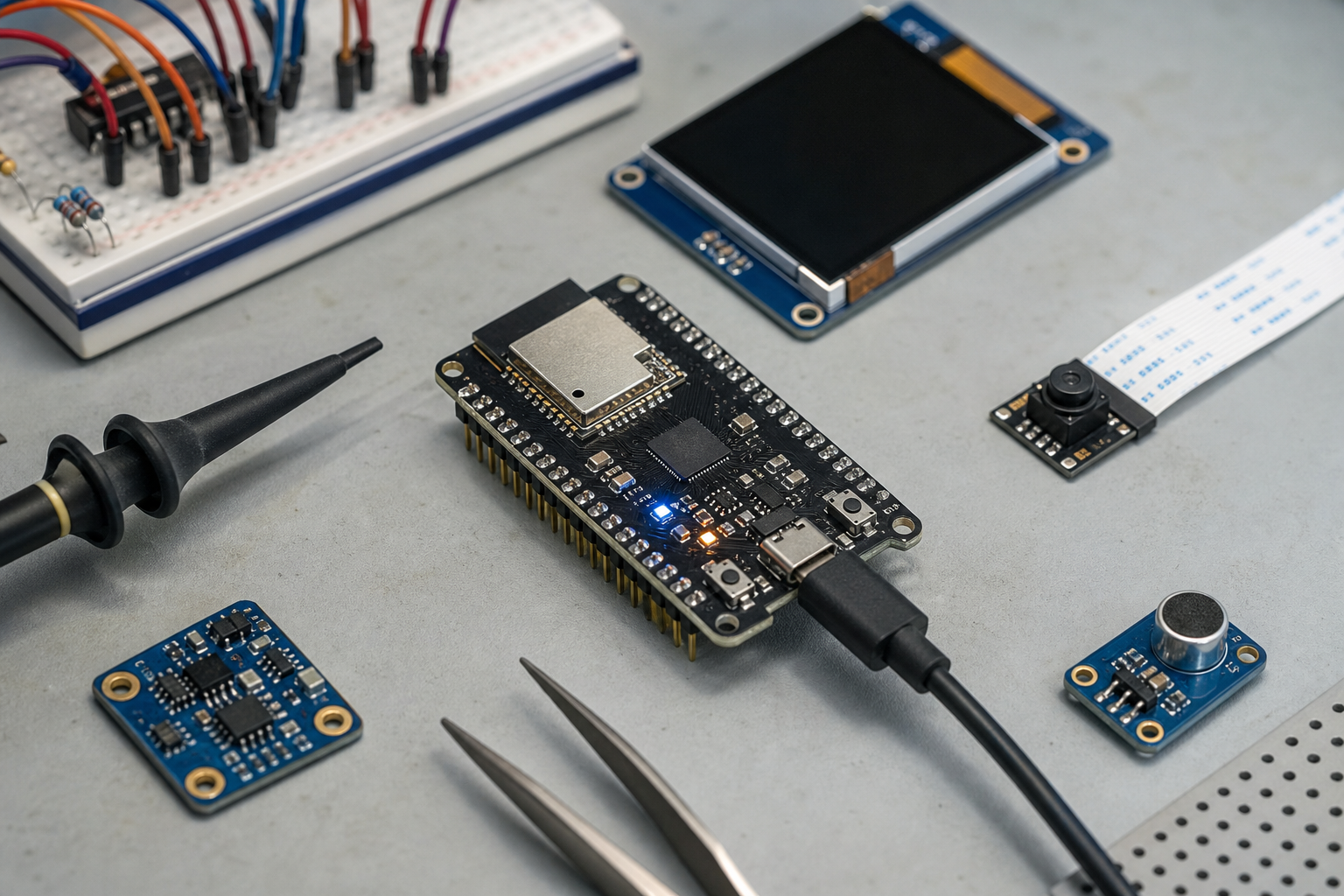
What Kind of Chip Is ESP32-S3?
ESP32-S3 is a wireless MCU and SoC in the ESP32 family, built for connected embedded products that need more application capability than a simple sensor node. In real projects, it shows up in smart control panels, voice interfaces, compact HMIs, camera accessories, retail terminals, educational AI kits, connected appliances, and low-cost edge devices with modest local processing needs.
It becomes especially attractive when one product discussion includes Wi-Fi, Bluetooth, display handling, microphone input, and a bit of local AI or signal-processing work in the same hardware generation.
Why It Is Hot This Week
The strongest demand pattern around ESP32-S3 is not only about the chip itself. It is about the type of boards and modules built around it. Voice interaction, small-screen interfaces, camera experiments, and local AI demos are still driving component interest, and ESP32-S3 is one of the most common entry points because it is familiar, widely supported, and cheap enough to stay realistic for volume products.
That matters for sourcing and product planning. When a chip keeps appearing across development boards, compact display products, and voice-control modules, it usually means the ecosystem is doing some of the selection work for engineers. The market is showing where teams feel they can move quickly.
Main Characteristics That Matter in Practice
ESP32-S3 is strongest when the product needs more interaction than a basic connected node but does not justify a much larger Linux-class system. It gives teams a workable path for display-driven interfaces, audio capture, moderate graphics, onboard control logic, and some lightweight AI acceleration tasks without pushing hardware cost or complexity too far.
Another reason it sells well is the development path. ESP32 tools, examples, and module supply are familiar to many firmware teams. That lowers friction during prototyping and often shortens the jump from experiment board to application-specific hardware.
Problem: Teams Try to Make One Board Do Every ESP32-S3 Demo at Once
ESP32-S3 gets shown in voice demos, camera boards, display products, AI kits, and wireless gateways, so it is easy to assume one product can combine all of that with little compromise. Then the board grows, memory pressure rises, power budgeting gets loose, and the schedule starts slipping.
Solution
Lock the first product role before the schematic settles. Decide whether the board is mainly a display controller, a voice interface, a camera accessory, or a general connected control node. ESP32-S3 handles many directions well, but the first release should have one clear center of gravity.
Problem: Display and UI Ambition Outruns Memory Planning
Many projects start with a small demo screen and a simple interface. Later they add fonts, icons, richer UI states, OTA partitions, certificates, audio assets, and debug features. Suddenly the memory picture looks much tighter than it did during the first prototype.
Solution
Budget for production firmware early. Count UI assets, OTA requirements, localization growth, certificates, logging, and recovery paths before saying the memory plan is safe. If the screen experience matters to the product, memory margin is not optional.
Problem: Voice Boards Look Easy Until Noise and Layout Show Up
Voice-enabled ESP32-S3 designs often look simple on paper because the digital microphone modules and example code are everywhere. Real boards are less forgiving. Power noise, speaker coupling, bad microphone placement, and weak enclosure decisions can quickly turn a good lab demo into poor field audio.
Solution
Treat the microphone path and acoustic layout as first-class design work. Keep noisy power and wireless sections under control, test audio inside the real enclosure, and validate the board during Wi-Fi activity instead of only during quiet bench capture.
Problem: Procurement Assumes Every ESP32-S3 Board and Module Is Interchangeable
This is a common commercial mistake. Two listings may both say ESP32-S3, but the flash size, PSRAM configuration, antenna design, USB path, display interface, camera connector, and certification status can differ enough to change real product risk.
Solution
Approve exact module or chip variants and document the configuration that the firmware and hardware expect. Purchasing should not be matching keywords only. Keep a clear approved-parts list with flash, PSRAM, package or module details, antenna assumptions, and any display or camera interface dependencies.
Problem: Teams Expect Heavy Edge AI from a Cost-Focused MCU Board
ESP32-S3 is useful for lightweight AI and inference-oriented tasks, but some teams overread that advantage and expect desktop-style vision or complex speech pipelines from a board that was never meant to carry that workload comfortably.
Solution
Use ESP32-S3 where the local AI work is targeted and efficient, such as keyword spotting, simple classification, or low-overhead signal interpretation. If the product roadmap points toward heavier multimodal processing, define that earlier and move to the right class of platform instead of stretching the MCU beyond its sweet spot.
Selection Notes
ESP32-S3 makes strong sense when the product needs wireless connectivity plus a more interactive embedded experience. It is particularly useful for small displays, smart panels, voice-enabled devices, compact HMIs, and low-cost edge products that need more than simple sensing.
It makes less sense when the project is either extremely simple or much more compute-hungry than the first concept suggests. In those cases, the right answer may be either a leaner ESP32 option or a higher class of processing platform.
Final Take
ESP32-S3 keeps selling because it fits a very active product zone: connected hardware that wants to look smarter, sound smarter, and feel more capable without becoming expensive or complicated too early. That is a real market reason, not just development-board hype.
If you are comparing ESP32-S3 modules, display-board options, or voice-oriented hardware directions, send the application details through our contact page. We can help review the tradeoffs from both engineering and sourcing angles.
FAQ
Is ESP32-S3 mainly for AI projects?
No. AI is part of the conversation, but many successful uses are still practical display, voice, HMI, and connected-control products.
Why does ESP32-S3 appear in so many voice and screen boards?
Because it offers a useful balance of wireless connectivity, application headroom, and ecosystem familiarity for interactive embedded hardware.
What usually causes trouble first in an ESP32-S3 product?
Memory planning, noisy voice hardware, and assuming all module variants are equivalent are some of the most common early mistakes.