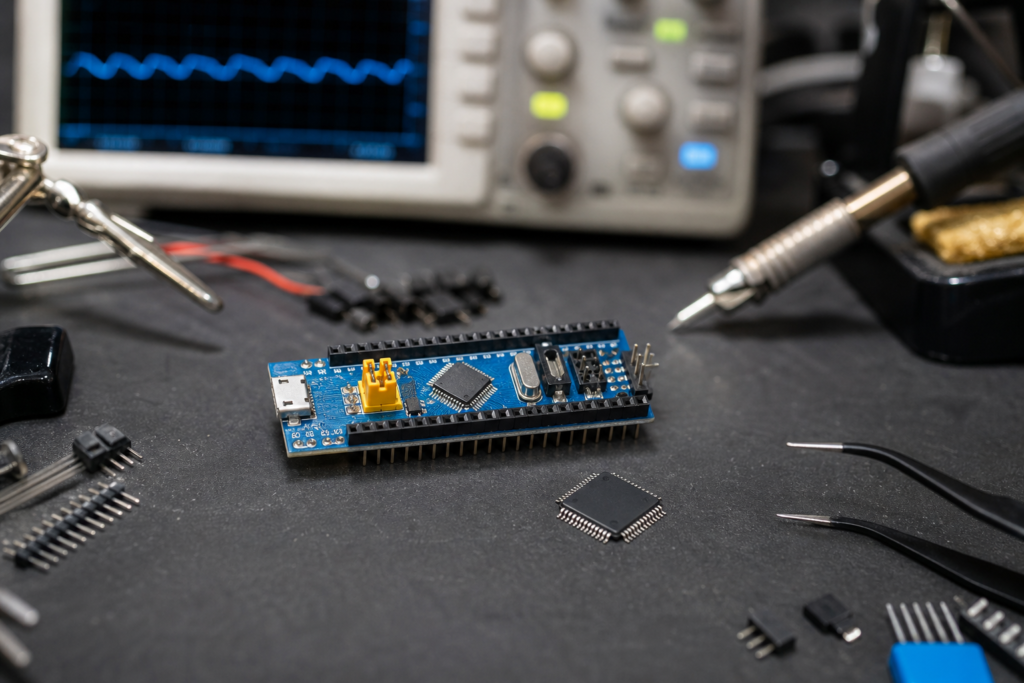
STM32F103C8T6 in 2026: Why This MCU Still Sells So Well
Some chips stay popular because they are technically ahead of the market. STM32F103C8T6 stays popular for a different reason: too many real products still depend on exactly what it does well. On Monday, July 27, 2026, it is still showing strong transaction signals in the Chinese component market, especially in small control boards, learning boards, repair demand, and low-risk continuation projects.
That matters because this is not only a nostalgia part anymore. When a chip keeps moving in volume years after engineers start calling it old, it usually means the market is voting for continuity. STM32F103C8T6 is still useful, still familiar, and still cheap enough to survive where newer parts do not clearly improve the outcome.
What Kind of MCU Is It?
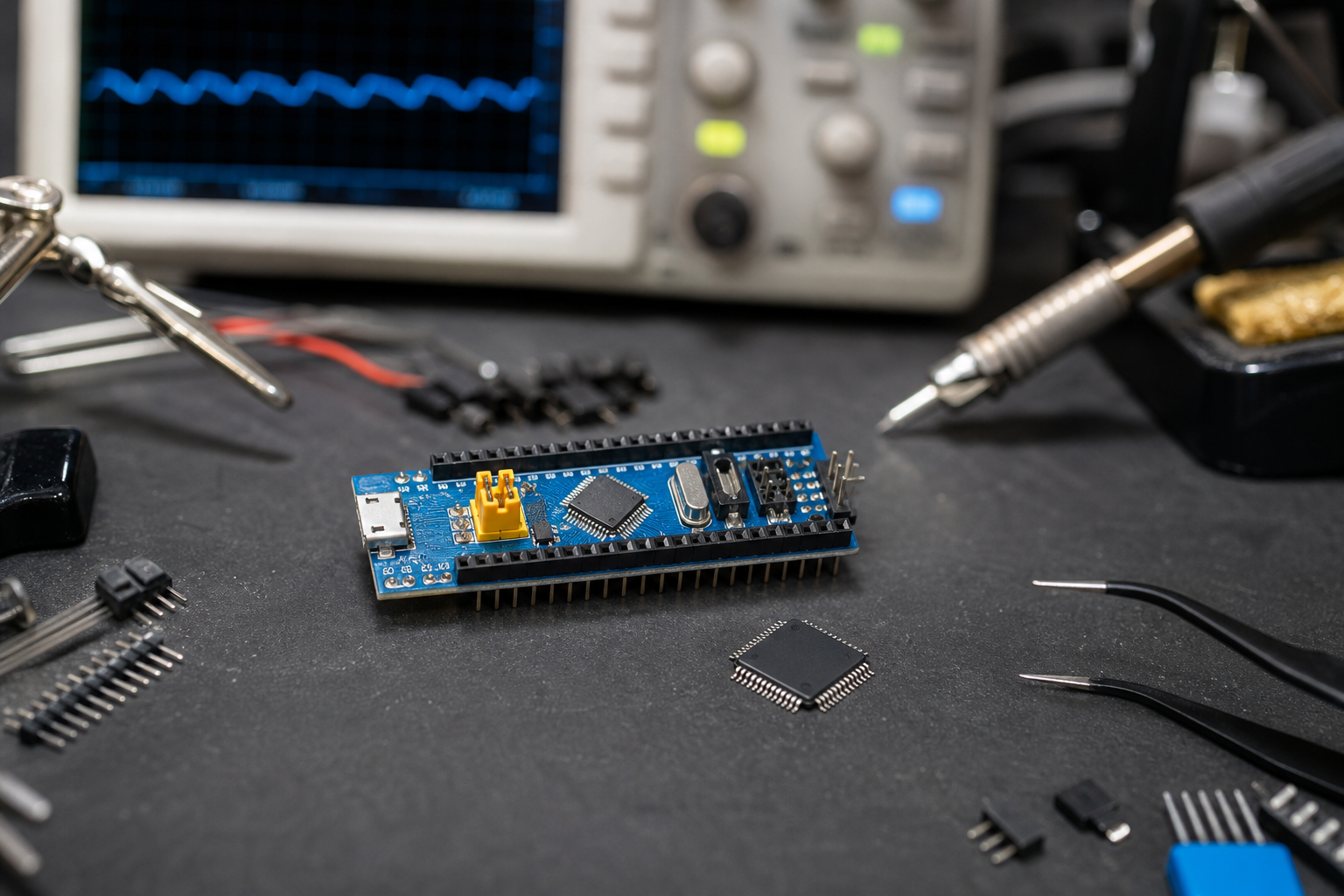
STM32F103C8T6 is a 32-bit Arm Cortex-M3 microcontroller that has lived on countless small boards for years. In practice, it remains common in industrial control boards, simple data-acquisition units, small HMIs, power-control subboards, motor-related circuits, educational hardware, and repair or clone ecosystems built around mature firmware.
It is not a glamorous choice in 2026, but glamour is not the point. This part survives where stable peripherals, known firmware behavior, and low redesign pressure matter more than new security features or a big connectivity roadmap.
Why It Is Still Hot
The demand pattern is easy to understand when you look beyond spec sheets. Many teams are not choosing between STM32F103C8T6 and a clean-sheet 2026 platform. They are deciding whether to keep an existing board alive, whether to reuse a stable firmware base, or whether to avoid unnecessary migration cost in a low-margin product.
Marketplace demand reinforces that picture. The part continues to appear in high-volume bare-chip listings, learning boards, and minimal system boards, which means the demand is spread across production, maintenance, education, and secondary design ecosystems rather than depending on one niche only.
Main Characteristics That Still Make It Practical
STM32F103C8T6 remains attractive because engineers already know its behavior. Toolchains, examples, community knowledge, and board-level habits around this family are mature. That maturity reduces bring-up friction, shortens debug time, and gives smaller teams more confidence when schedules are tight.
Another reason is that many products simply do not need a modern security-heavy or wireless-heavy MCU. If the task is relay control, sensor reading, serial communication, keypad handling, or stable embedded control with proven code, the older platform can still be a reasonable business choice.
Problem: Teams Keep Using It Without Rechecking Supply Risk
This is one of the biggest traps. A part can remain popular and still become awkward to source consistently. High-volume legacy demand often attracts mixed-quality channels, inconsistent markings, relabeled stock, and confusion around package, capacity, or origin.
Solution
Do not approve the family name alone. Approve exact part numbers, package expectations, date-code rules where relevant, and supplier tiers. If the board is production-bound, buy comparison samples from more than one channel and verify programming, current draw, thermal behavior, and peripheral stability before assuming the source is safe.
Problem: Existing Firmware Creates False Confidence
Legacy firmware can be a strength, but it also makes teams underestimate hidden board assumptions. The code may have timing behavior, peripheral mappings, ADC sampling patterns, boot expectations, and startup quirks that are stable only because the hardware stayed exactly the same.
Solution
When you continue with STM32F103C8T6, document what the firmware actually depends on. Separate application logic from board-specific behavior and identify the critical peripherals early. That way, if sourcing pressure later forces a package variant or migration path discussion, the team already knows where the real dependencies live.
Problem: Designers Use It for New Projects by Habit
This is where the part becomes risky. Engineers who have used STM32F103C8T6 many times can default to it automatically, even when a newer device would solve the problem more cleanly. Habit is not the same as fit.
Solution
For new projects, start from requirements instead of familiarity. If the design needs modern security, lower-power modes, richer memory margin, stronger long-term roadmap support, or integrated connectivity planning, then STM32F103C8T6 may no longer be the right baseline. Use it when it matches the job, not when it merely matches team comfort.
Problem: Procurement and Engineering Talk About Different Substitutes
This happens often with mature MCUs. Purchasing may see one acceptable listing and assume it is close enough. Engineering may be thinking about memory size, boot mode, pin mapping, temperature grade, and firmware impact. That mismatch turns a cheap purchase into a redesign meeting.
Solution
Create a substitute ladder. Mark parts as true pin-compatible options, low-risk engineering review options, and migration-only options. Put package, flash size, temperature, and firmware impact in writing. That gives procurement room to move without blurring technical boundaries.
Where It Still Makes Sense
STM32F103C8T6 still makes sense in mature low-cost control hardware, maintenance-heavy products, training boards, and projects where continuity matters more than platform modernization. It is especially useful when the board and firmware are already proven and the main business goal is stable supply at workable cost.
It makes less sense in new connected designs, security-sensitive products, or software-heavy platforms that will need meaningful feature growth over the next few years. In those cases, using an old favorite just because it is familiar can become an expensive shortcut.
Final Take
STM32F103C8T6 is still selling well in 2026 because it solves a very practical market problem: many teams want the lowest-friction path to a working control system. That does not make it the best MCU for everything. It makes it a part that still deserves an honest, disciplined selection process instead of a reflex decision.
If you are comparing STM32F103C8T6 with replacement options, or trying to judge whether an existing product should stay on it or move away, send the target board and use case through our contact page. We can help review the tradeoffs from both engineering and sourcing angles.
FAQ
Why is STM32F103C8T6 still popular in 2026?
Because many products still need stable, low-cost control hardware more than they need a new platform. Mature firmware and familiar development flow keep it commercially relevant.
Is STM32F103C8T6 still good for new designs?
Sometimes, but not automatically. It can still fit simple control boards, yet newer products should be judged against power, security, memory, and roadmap needs before defaulting to it.
What is the biggest risk when buying STM32F103C8T6 now?
Supply consistency. Teams should verify exact part variants, package expectations, and source quality instead of treating every listing as interchangeable.